Roller Coaster
Faster than a speeding bullet. More powerful than a locomotive. It’s a … roller coaster? Well, they may not be quite as fast as a speeding bullet, but unlike Super Man, roller coasters don’t need any super powers in order to fly, spin, and race through the air at top speeds. What do they need? Physics.
Teaching Physics through Roller Coasters
If you want a fun, interesting way to teach children about physics, particularly about potential and kinetic energy, then taking them on a field trip to a theme park is a great idea. Learning how roller coasters work is a fun way to reinforce what children are learning about Physics in school.
Before taking children to a theme park, teach a simple physics lesson to get their imaginations engaged.
Start with an illustration to peak their interest. For younger children, use a colorful, plastic marble slide.
For older children try making one of these cool mine shaft marble slides from LooLeDo. Try to find or make slides with multiple hills and dips. This is important to the concept of potential energy and kinetic energy. Alternatively, you can show a video or movie about a theme park with roller coaster rides.
For younger children who might not yet understand the concept of gravity, you can teach them about Sir Isaac Newton and the apple. Perhaps purchase some fabric apples so that children can drop them on each other’s heads to illustrate how the apple fell out of the tree and onto Newton’s head. (Toy fabric fruit can be purchased from some toy stores, or on handmade Web sites like Etsy and Folksy.) Remind children not to try this with real apples.
Explain Physics Terms
- Physics is the science of how matter (objects, people, animals, etc.) relates to motion and energy. Energy is what allows matter to move.
- Gravity is the force that draws two objects (or two pieces of matter) together, or the force that pulls objects downward, toward the earth.
- Potential energy is based on the mass, or size and weight, of an object, and where it rests.
- Kinetic energy is based on motion, or the speed at which an object travels.
- Velocity is the speed at which something happens, or the rapidity of motion.
Demonstrate these Physics Concepts
Show them the slide again, and explain how the marble (or small car, or whatever you choose to roll down the slide) has potential energy based on its position at the top of the slide.
The higher the hill, the more potential energy, and the higher velocity the marble has because gravity can pull it down further and faster. As the marble begins to speed down the hill, it gains velocity, and the potential energy converts to kinetic energy which propels the marble over the next hill, around the first curve or loop, and on for the rest of the journey.
While the marble loses potential energy as it loses height, it gains kinetic energy which then propels it up the next hill. The pattern of potential to kinetic energy continues, and this cycle is what keeps the marble rolling all the way to the end of the slide.
Build Your Own Roller Coaster
Let children play with the marble slides from your illustration, or build a model roller coaster together.
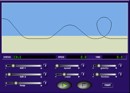
Create your own rollercoaster simulation on Funderstanding.
Take a Field Trip to a Theme Park
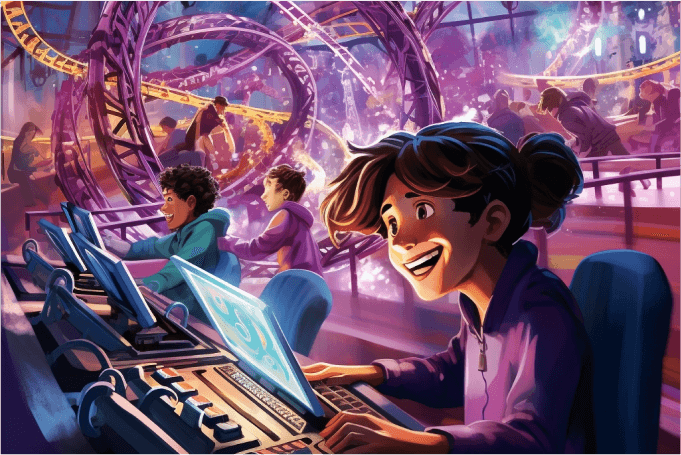
Now that they’ve had a chance to learn some basic Physics concepts, plan a field trip to a theme park where they can see potential energy and kinetic energy at work in the real world.
As children ride the rides, remind them of some of the lesson points. Perhaps offer them a small prize every time they correctly identify one of the points you made in the lesson. Or you could allow them to go on a roller coaster only after they explain to you how it works.
You can also give a pop quiz on the ride home, or provide them with an activity handout.
Follow-Up on Physics Concepts
Following your theme park visit, give a short review lesson to remind them what they learned about Physics and roller coasters.
Talk about the experience at the theme park. Ask your children what they enjoyed most about the experience, and what they remembered from the lessons. Maybe make a model roller coaster or play a roller coaster game to refresh their memories.
Roller Coaster Resources
Encyclopaedia Britannica talks about the the history and inventors of roller coasters here. On the Discovery Kids Web site you can build your own roller coaster, the idea being—the scarier the better:
Answer their questions. If you don’t know the answer, help them find out what they want to know by showing them how to search for articles with Google or another search engine.
Teaching children about Physics can be daunting. By providing fun, engaging illustrations, and taking them on a field trip to a theme park, you can make the whole experience fun and interesting for everyone.
By Megan Elaine Cullen
Add a Comment Hide Comments

I enjoyed this article. Thanks for making something I never really understood fun.